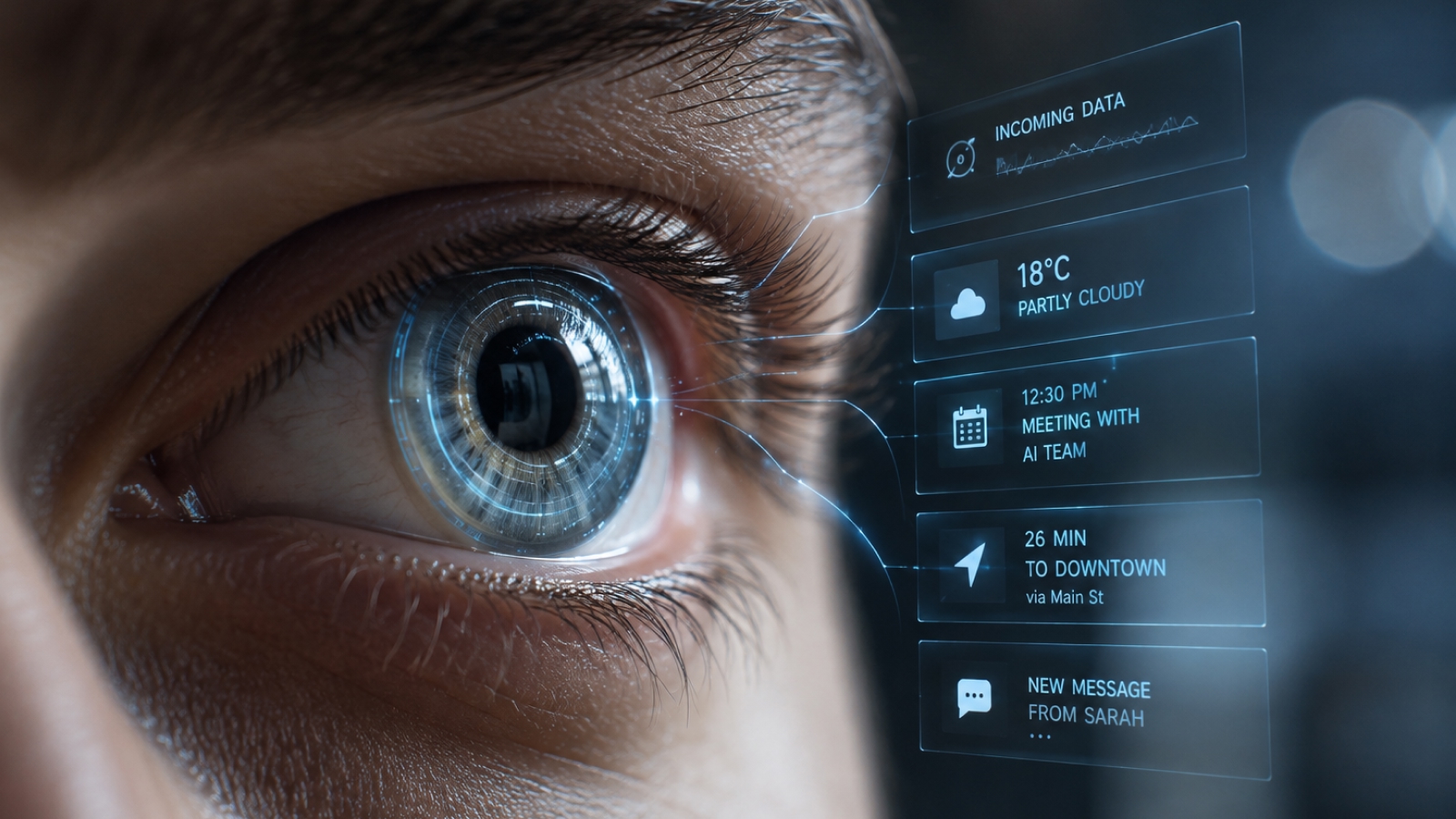
The Senses as an API
The next major wave of artificial intelligence won't be happening on your monitor; it's being designed to operate directly through your senses. The foundational technology is already arriving, not as a single blockbuster product, but as a slow convergence of smaller, more capable devices. We're on a trajectory where our eyes and ears become simple inputs for an AI, which basically means what we see and hear can be processed in real time and annotated with information whispered back to us.
Companies like Nvidia are developing AI models capable of real-time listening and contextual response. At the same time, we're seeing rumours of cameras being added to devices like Apple's AirPods. We already have smart glasses from Meta and others that overlay information onto the world. For now, these things are somewhat clunky and obvious. But the history of technology is a steady march toward miniaturization and invisibility.
It's not a huge leap to imagine these tools shrinking into devices that are functionally invisible; a tiny earbud, a contact lens. When that happens, the AI has access to your entire sensory experience. It sees what you see, hears what you hear. And it can tell you what to do about it.
I’ve spent my career getting distracted by new technology, and I’ve learned that the most profound shifts are the ones that change the definition of a basic human activity.
Instant Expertise, Questionable Understanding
This capability opens up some rather interesting scenarios. Let's say I'm invited to deliver a keynote at a national plumbing convention. My personal knowledge of this is... little to non-existant. But in this near future, that might not matter.
With a discreet device in my ear, I could stand on stage and speak fluently about the tensile strength of PEX piping versus copper, or the nuances of local building codes in different municipalities. The AI would listen to the questions from the audience, search a vast repository of plumbing knowledge, and feed me the correct answers. I wouldn't need to understand the topic; I would just need to be a convincing narrator.
Or consider a more hands-on example. I could decide to fix the transmission in my car, a task for which I am profoundly unqualified. But if I'm wearing smart glasses, an AI can see the engine bay exactly as I see it. It could then feed me instructions and examples in real time.
“See that bolt to the upper left of the red cable? That's the one. Use a 10mm socket to loosen it.”
“Now, gently detach the housing. Be careful not to dislodge the green sensor connected to it.”
The AI would whisper sweet, step-by-step nothings in my ear until the job was done. I could likely build a passable birdhouse this way. I'm less confident about performing my own dental work, but the principle is the same. I'd be able to perform the task without possessing the underlying knowledge, skill, or experience.
The Point of Knowing Things
And that's where the truly difficult questions begin. If anyone can access the knowledge to do almost anything, what is the value of an expert? Expertise, in this model, becomes a utility, like electricity. You don't need to own the power plant; you just need to pay your bill to access it.
The thing is, this isn't just about trades or public speaking. It applies to nearly any field of knowledge work.
Why would a junior marketer need to learn the principles of media buying if an AI can analyze the market and tell them exactly where to place the ads? Why would a law clerk spend years memorizing case law if an AI can produce the relevant precedent in a fraction of a second?
This brings us to a rather fundamental point. What is the purpose of education in a world of instant, augmented knowledge? What is the role of critical thinking when an AI can provide the 'correct' next step? I've been chasing 'the next big thing' long enough to know most big things turn out to be medium-sized things, but this one feels different. It chips away at the connection between doing and knowing.
I don't have the answers, and I'm somewhat suspicious of anyone who claims they do. But these aren't distant, science-fiction questions anymore. The hardware is in production and the software is being written. This seems to shift the focus from 'will AI take my job?' to 'what does it mean to know how to do a job at all?'. It's a less comfortable question, but probably the more important one.